____ _ | __ )| | ___ __ _ | _ \| |/ _ \ / _` | | |_) | | (_) | (_| | |____/|_|\___/ \__, | |___/_ _ _/_| |__ ___ _ __| |_ _ _/_ / _ \ '_ \ / _ \ '__| | | | |/ _ \ __/ |_) | __/ | | | |_| | __/ \___|_.__/ \___|_| |_|\__,_|\___|
[2025-11-19][Daily]
In the convolution layer I have something like this:
dahl_tensor* convolution_forward(...)
{
    // Initialize the result tensor
    dahl_tensor* output_batch = tensor_init(arena, conv->output_shape);

    tensor_partition_along_t(output_batch, DAHL_MUT);
    tensor_partition_along_t(input_batch, DAHL_READ);
    tensor_partition_along_t(conv->filters, DAHL_READ);

    for (size_t i = 0; i < batch_size; i++)
    {
        // launch tasks per sample
    }

    tensor_unpartition(output_batch);
    tensor_unpartition(input_batch);
    tensor_unpartition(conv->filters);

    return output_batch;
}
So I partition everything, launch task for each sample, then unpartition everything. Unpartitioning also means, synchronizing everything so we get our complete tensor with every values correct.
But then in the next layer I will do the same: (note that I refactored RELU to be a layer itself, that's what made me think about this in fact).
void relu_forward(dahl_relu* relu, dahl_tensor* input_batch)
{
    tensor_partition_along_t(input_batch, DAHL_MUT);
    tensor_partition_along_t(relu->mask_batch, DAHL_MUT);
    size_t const batch_size = GET_NB_CHILDREN(input_batch);

    for (size_t i = 0; i < batch_size; i++)
    {
        dahl_block* input = GET_SUB_BLOCK_MUT(input_batch, i);
        dahl_block* mask = GET_SUB_BLOCK_MUT(relu->mask_batch, i);
        TASK_RELU_SELF(input, mask);
    }

    tensor_unpartition(input_batch);
    tensor_unpartition(relu->mask_batch);
}
So here I get the input_batch, which is the output from the convolution, partition it again, do things, then unpartition again. In fact from the beginning we could just, not unpartition, and prevent synchronizing at each layer???
Looking at a comparison, we clearly see it changes a lot. That's very good, however we will need to integrate this cleanly in the API: Should I always let the output result partitioned? Does the user need to unpartition it by hand? How do I recognize which layer is the first/last one?
After trying this with other layers I face another issue:
If I apply other types of partitionning on the data, it seems its not possible. For example from relu to pooling, the data gets partitioned as such:
However If I apply the same trick as before, starpu crashes because we try to partition data that is empty. That's a concerning limitation, yet it makes sense because I could in theory publish all the partition plans of data and its sub data in one pass and I would mess up the results.
1. One solution is to remove partitioning on the filter dimension. So we would rework codelets to produce multiple feature maps instead of one. We would also need to reword the flatten layer, so that it returns partitioned data.
Nevertheless, we should really think of organizing similar tasks (but with different partition granularity). For example, do I write two times cross_entropy_batch and cross_entropy? Can't I just have a codelet that either launches cross_entropy_batch with matrices as arguments and cross_entropy with vectors as arguments? The advantage of this last point is that it will be very interesting for "self adjusting task size scheduling".
2. Another solution, fast but not clean (maybe try this before hopping into big refactors from solution 1?), it to submit wait tasks (with 0 seconds of wait, we just want to acquire the data) so that we ensure that the partition is done after?
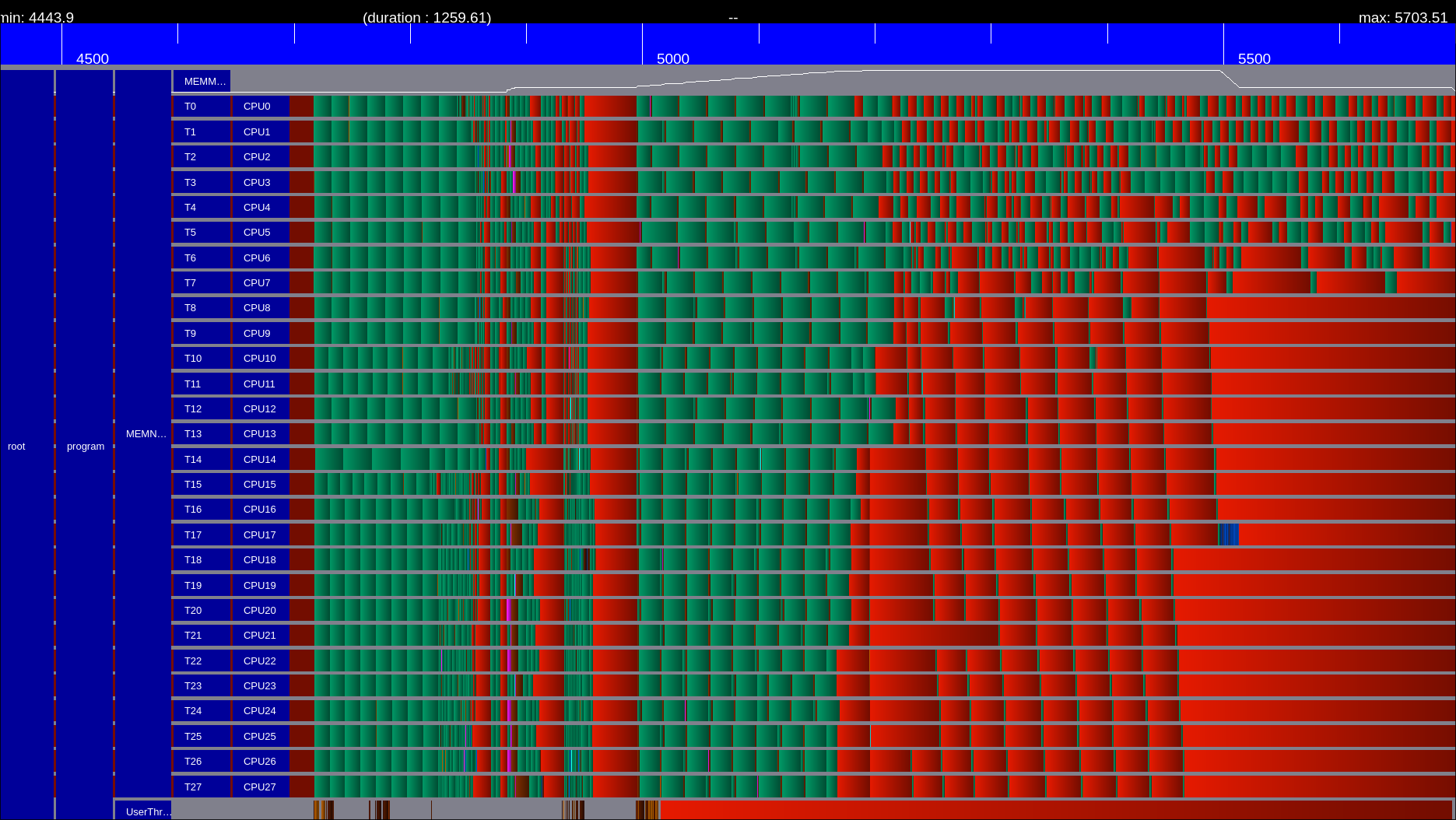
Turns out solution 2 is really great, and does work seamlessly. As a reminder, here is the state of scheduling before:
And now, we still notice sleep time between relu backward and conv backward, yet there is no task to blame for, which is pretty strange. The other layers are pretty solid on the graph, it seems like this is a really great solution:
Now we just need to refactor loss,pred,grad and flatten layer so that the dense layer can use the same trick too.
Flatten layer and gradient calculation have been refactored, here are the results:
.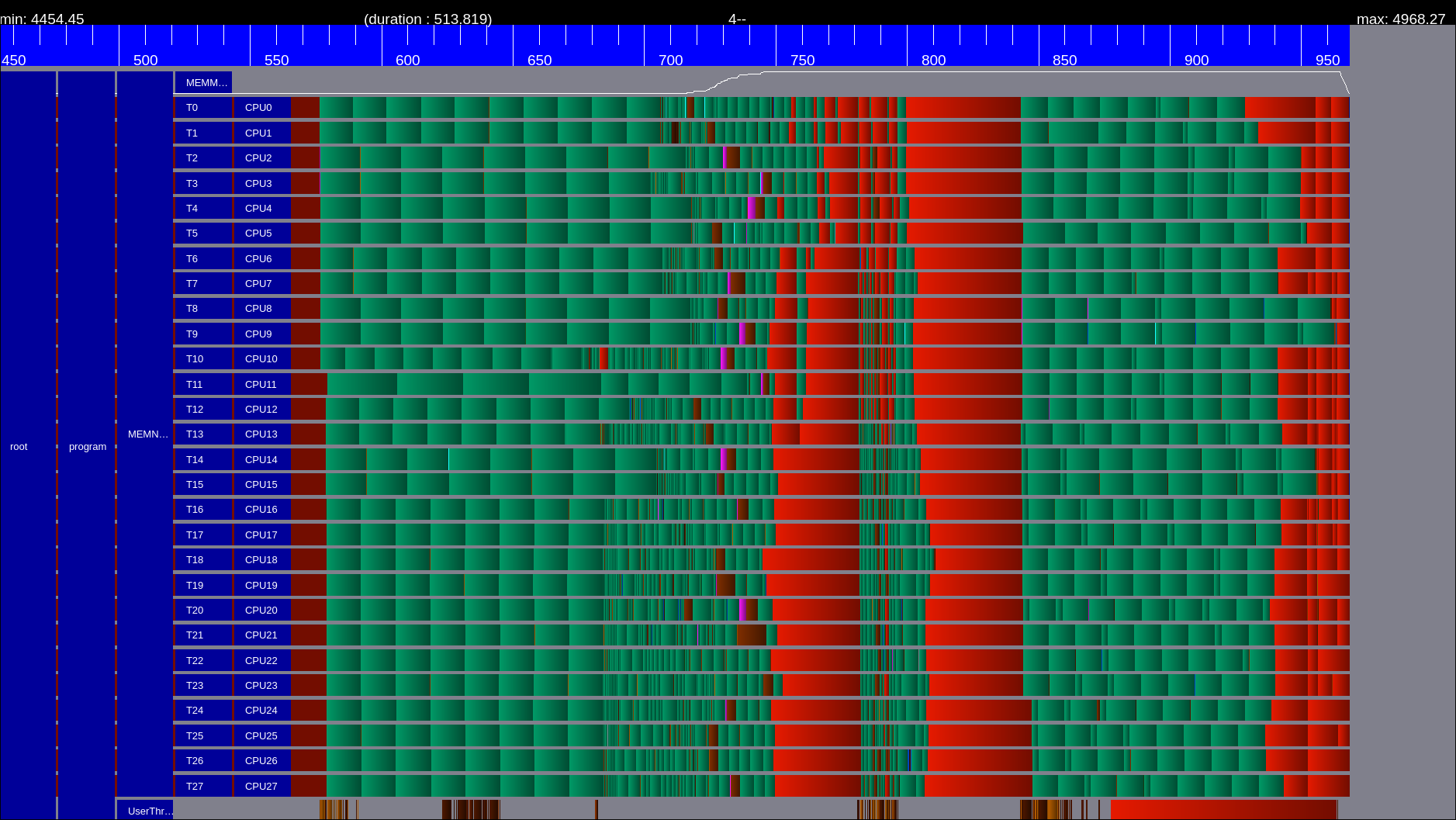
We notice that everything works well, but two strange sleeps between respectively: dense backward and pooling backward, relu backward and conv backward
This seems very weird because no dependency should block it like this?