____ _ | __ )| | ___ __ _ | _ \| |/ _ \ / _` | | |_) | | (_) | (_| | |____/|_|\___/ \__, | |___/_ _ _/_| |__ ___ _ __| |_ _ _/_ / _ \ '_ \ / _ \ '__| | | | |/ _ \ __/ |_) | __/ | | | |_| | __/ \___|_.__/ \___|_| |_|\__,_|\___|
[2026-01-20][Daily]
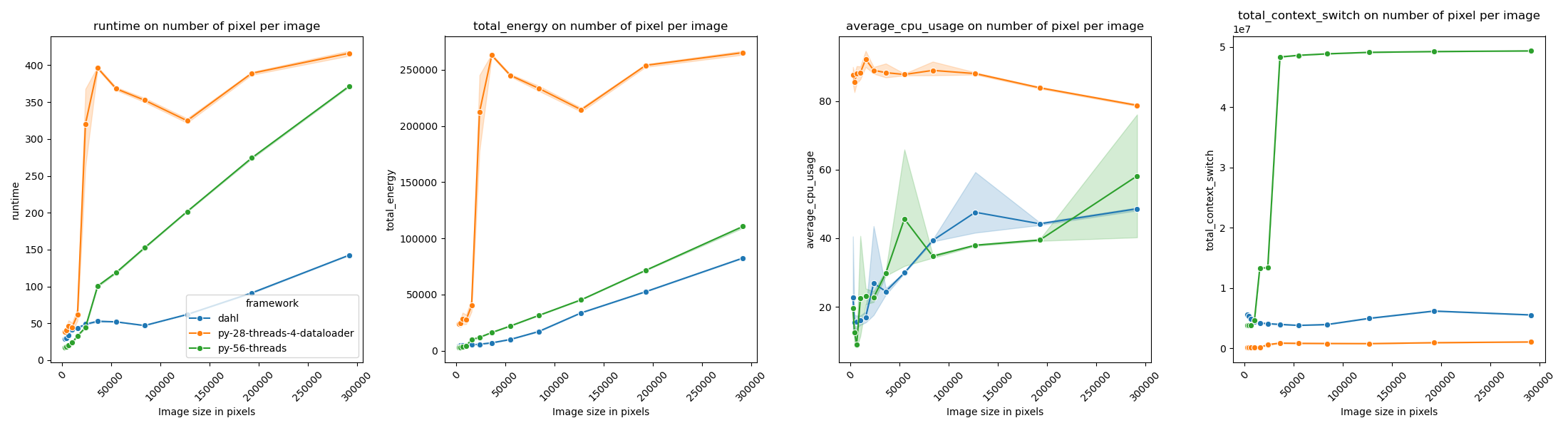
Trying to see if bad perf on pytorch was due to dataloading: we use 4 data loader, 28 threads. Indeed, using async loading with 4 workers already improves a lot performances. yet it stays worse than using more threads.
Concerning why previous experiments had better results with 56 threads instead of 28 == numcpu, I think the explanation comes from the fact that my CPU has 2 thread per core:
andrew@rammus ~/d/n/e/workload (main) [nix]  [127]> lscpu
Architecture:                x86_64
  CPU op-mode(s):            32-bit, 64-bit
  Address sizes:             46 bits physical, 48 bits virtual
  Byte Order:                Little Endian
CPU(s):                      28
  On-line CPU(s) list:       0-27
Vendor ID:                   GenuineIntel
  Model name:                Intel(R) Core(TM) i7-14700K
    CPU family:              6
    Model:                   183
    Thread(s) per core:      2
    Core(s) per socket:      20
    Socket(s):               1
    Stepping:                1
    CPU(s) scaling MHz:      18%
    CPU max MHz:             5600.0000
    CPU min MHz:             800.0000
So using 56 (28*2) threads and obtaining better performances actually makes sense, I guess? But it seems to increase context switches by a lot.